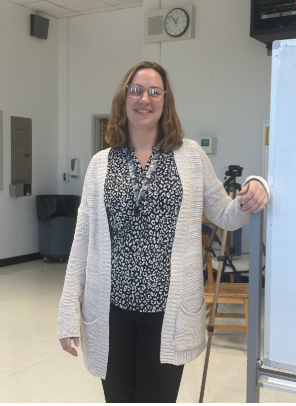
I think that as students, we can all agree that there is one thing that every single one of us has come to dread: the infamous math test. However, despite the negative stigma behind math, I think that there is more to math than boredom and difficulty, than sines and cosines or postulates and theorems. Behind every math class, there is also a math teacher. So, for this teacher feature, I thought, who better to interview than a math teacher herself?
Join me for this exclusive teacher-feature interview of Mrs. Vona, an Algebra 2 teacher here at Freehold Boro, and get a fascinating peek into the life of one of Boro’s very own teachers. I don’t know about you, but I sure learned a lot!
———————————————————————————————————————
Samyuktha: What inspired you to become a teacher?
Mrs. Vona: So, when I was in high school, I actually had no idea what I wanted to be. I was in the International Studies magnet program at Township at the time, and I knew I definitely didn’t want to do that. And then my mom put the idea in my head [that] “oh, like, you should think about being a teacher”. So, I started thinking about it, and then, in my senior year, I took AP calculus, and I really enjoyed it a lot. That was my 1st AP or honors math class ever. And I really liked that class, so I said, “Well, if I’m gonna teach, I want to teach something that I like”, and I really enjoyed that. So, I said, “Maybe I’ll be a math teacher”, and then I started taking math classes in college, and took the rest of my education classes in college, and I was, like, “This is great”. So, that’s what I decided.
Samyuktha: How would you describe your teaching philosophy?
Mrs. Vona: I would say I always want to do and teach every concept or every idea very thoroughly. And I always want to teach things in a way that will help students be successful in future math classes or future STEM fields, or to give them a strong enough foundation so that if they want to do more, they have adequate knowledge and skills to do so.
Samyuktha: What do you think students learn more from you beyond the curriculum?
Mrs. Vona: Well, I hope that they learn that practice makes perfect. And hard work pays off. And even if you’re struggling with something, if you practice it, and practice it, and practice it, you will get better at it. And I feel like sometimes people look at math teachers in general, and think, “Wow, you’re such a genius, ’cause you know how to do all these things”, when the reality is, I’ve just done questions like this hundreds and hundreds of times. And that’s why I understand it in a way that you guys [us students] don’t know because you’re just starting out understanding these concepts, but truly, you can do almost anything or understand almost anything if you work really hard at it.
Samyuktha: What has been your most rewarding moment as a teacher?
Mrs. Vona: Having conversations like this, hearing from former students and talking to former students who have either gone on to take other classes after me, [either] still in high school, or in college, and they say [they are] pursuing a STEM field, or they’re going to grad school, [or] they’re pursuing something like that. And just hearing about that, hearing how I was even just one step in their journey, to do something like that, really… I don’t know, [it] just really makes me feel good and makes me, like, “wow, like, you know, I helped you in some way, shape or form, get to that point”. You know?
Samyuktha: How has teaching changed you as a person?
Mrs. Vona: Definitely has given me a lot of patience. Definitely has, I think, opened my eyes to how different people see things, and that not everybody is looking through the same lens all the time. And… I would say also, maybe I’d like to reverse the question a little bit. I feel like having my own kids changed me as a teacher, because I want to be the kind of teacher that I hope my own kids would have, and just be a little more empathetic. [Also, I] definitely hold a certain standard, because I want everyone to meet that standard or exceed that standard, that’s always my goal, but also, [I realize] that everybody’s different, so some people need different things to get there. And even if people don’t kind of meet where I feel my expectations are, sometimes coming close to it is good enough for that person.
Samyuktha: How has teaching changed over the years?
Mrs. Vona: Well, when I started teaching, we did not have Chromebooks, and everything was pencil and paper, and in a way, I sort of prefer that, because I just feel like math and just writing in general is a completely different process than typing, and looking at something on a screen is a different process than writing something or talking to someone about it. So in a way, I wish we were less dependent on that, but also, I feel like there’s so many amazing changes that have happened. Back when we had graphic calculators, it would be five thousand steps to try to just graph a function. And now that technology has gotten so much better because we use it. Like, I would spend half a period trying to teach how to type in something on there [the calculator] so that it would come up, and I don’t have that problem anymore. So that’s an amazing change. But, yeah, there’s so much more I could probably say about this, but I try to keep things the same as they always were. With some exceptions.
Samyuktha: This is a very cool question for me. What’s one thing your students might be surprised to learn about you?
Mrs. Vona: I feel like this is the fact that I always go with, but in college, I did competitive ballroom dancing, and I was the captain of my team in college and performed competitively.
Samyuktha: That’s so cool.
Samyuktha: What do you hope your students remember about you years from now?
Mrs. Vona: I hope they remember something from my class—even one or two things would be amazing. I hope that they remember that maybe sometimes I give a lot of work, but I hope that I was fair, and I hope that… I hope they remember at least one or two funny, good moments from our class, because I feel like when students come back, that’s what they always talk about. They always talk about, like, a fun thing that happened, or this conversation or that conversation, and that’s what people remember. They’re not gonna remember, like, “what’s the inverse function of a square root graph”. I hope they do, but [more than that], I hope that they remember how they felt rather than the material.
———————————————————————————————————————
Thank you so much, Mrs. Vona, for taking the time in your day to be interviewed. It was a pleasure to hear your responses to these questions, and I had a great time. It was so interesting to hear a teacher’s perspective on things— especially as a student of yours.
I sincerely appreciate all of you readers as well, for reading until the very end (or you skimmed, I will never know).
I hope that next time, when you think about putting off your math homework, you’ll remember Mrs. Vona’s advice: practice makes perfect, and hard work always finds a way to pay off.
Have a great Boro day, everybody!
Now, if you’ll excuse me, I’m gonna go do my own math homework.